
How it works
Your files move.
Yet we never own them.
SFTP.cloud is a managed file transfer service built on an unusual premise: that the company running your file transfer should never host your files, and should never possess the credentials to access them, reach your storage, or alter the record of what happened.
That premise is a direct consequence of how the system is designed, and this page explains exactly how that works.
No credit card. No feature locks. Walk away by doing nothing.
The components
Three parts. Only one of them is near your files.
Architecture is why you would trust it. This is why you would use it.
-
Your Storage Connector
A small service you deploy next to your storage: in your datacenter, in your VPC, or in your cloud account, installed as a service or running in a docker container. It reads and writes your files using credentials that never leave your network, and it runs any automation you configure.
-
The SFTP.cloud Head
The public endpoint your partners and users connect to, sometimes also referred to as the “Protocol Head”. It terminates SFTP, FTPS, FTPES and HTTPS, authenticates the user, and applies the first set of your access rules. It holds no files and no storage credentials.
-
The control plane
Where you configure everything: accounts, permissions, automation, policies. Your Connector and your administrators both reach it outbound. There is never an inbound rule to be allowed through your firewall.
The mechanism
A file transfer, start to finish.
Automation
Automation that runs
under your control
Most managed file transfer platforms run automation on their own infrastructure. If you want a file decrypted, scanned, renamed, split, or routed by content, their servers have to read it.
SFTP.cloud runs automation on your Connector instead, in a full JavaScript environment called SyncJS. PGP decryption, malware scanning, checksums, renaming, content-based routing, a call to your internal API when a partner delivers: all of it executes inside your network, on infrastructure you control, using tools you chose.
And because event-handlers can run before an operation as well as after it, a script can block a transfer before it begins. Block an upload before it starts, selectively censor a directory list, you name it.
You get the automation. We never get the file.
HTTPS access
The same storage,
through the browser.
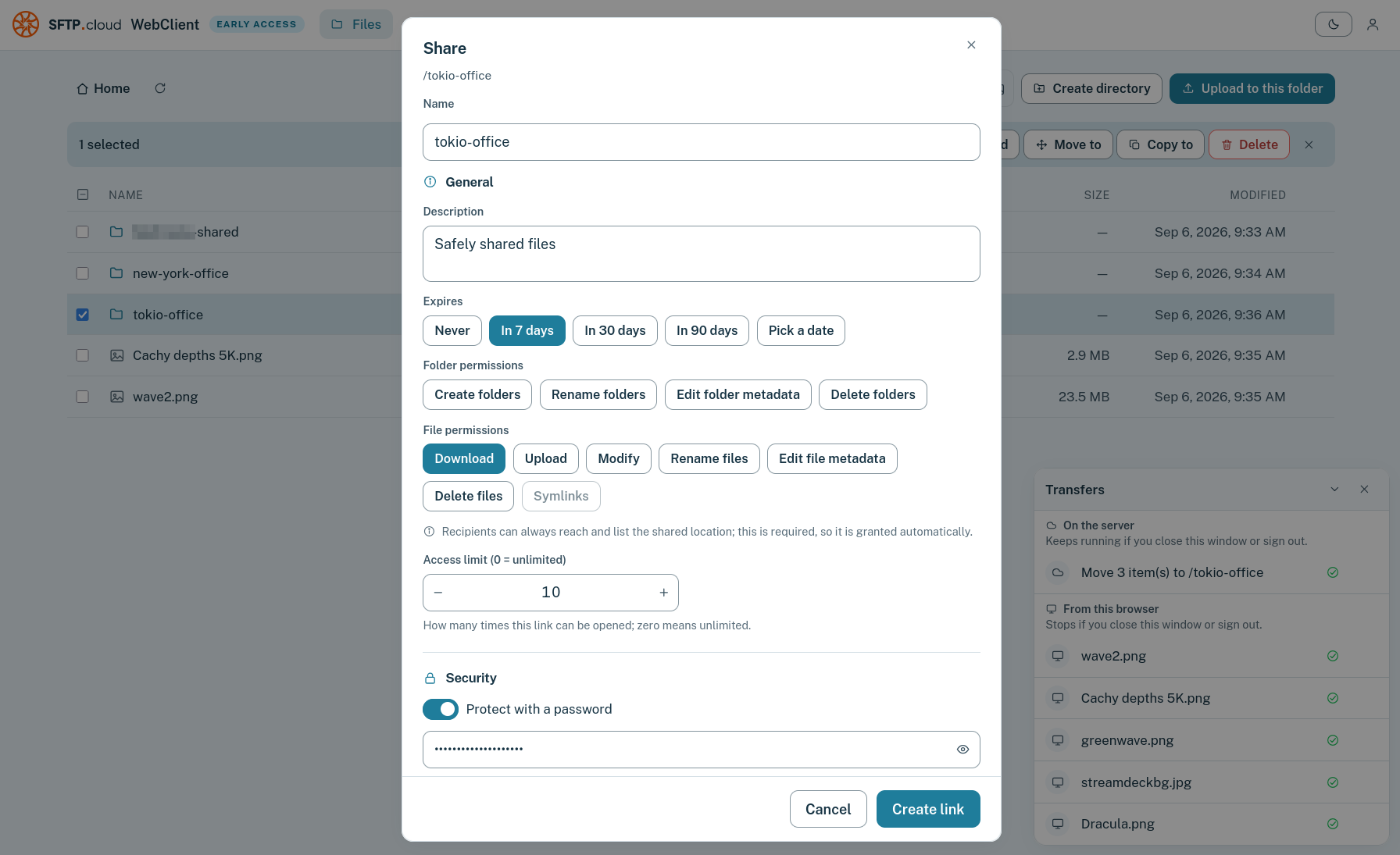
Not every user has an SFTP client. The WebClient gives them the same virtual file systems, permissions and audit trail over HTTPS, with server-side transfers that finish even when the browser doesn't stay open.
Failure modes
What happens when things go wrong?
If your Connector goes offline
Transfers to that storage stop. Users receive a clean error rather than a hang. The Connector reconnects on its own when it comes back, and nothing needs to be reconfigured.
If your network drops mid-transfer
The transfer fails. It is not silently committed, and both audit chains record the failure.
If the Head has a problem
Your storage is untouched and your data is unaffected. You lose the ability to accept new connections until we are back. Your files were never here to begin with.
If someone compromises our infrastructure
They find no customer files, no storage credentials, no way to dial down into your network, and no ability to forge your audit trail.
Deployment
Deploying the Connector.
1
Run it wherever your storage lives.
On a server in your datacenter, as a container in Kubernetes, or as a small instance in the same cloud account and region as your bucket. Deploy more than one for redundancy or to reach storage in different networks.
2
One outbound rule, nothing else.
It needs to connect outbound-only to the SFTP.cloud Portal, and to your SFTP.cloud Head on port 7600. Nothing else. Those are the only firewall rules you'll need, and they’re outbound, no one can get in through them.
3
The storage you already own.
Connect local storage, SMB/NAS/SAN, an upstream SFTP server, Amazon S3 or an S3-compatible store, Azure Blob Storage, or Google Cloud Storage. Hold the files in plain form, or encrypted with a key that stays on the Connector.